
How to Search Cases by Name
The MiCOURT Case Search is the place to start a Sanilac County name search. Pick the likely court first. The local identifiers are C24 for the 24th Circuit Court and D73A for 73A District Court. P76 is Probate Court. The inquiry takes a last name plus an optional first name. The older official guide offered a Begins With choice. Try a narrow spelling before a broad one, since wide searches pull in unrelated results. A name hit is only a lead, not the answer. Confirm the court, the case year, and the category. Check the public case number too before you treat the entry as the matter you want.
- Open MiCOURT Case Search in a current browser and select C24, D73A, or P76 for the Sanilac County court that likely holds the case.
- Choose a supported category, then enter the last name and an optional first name using the most exact spelling available.
- Add a filing year or case type when the result list is broad. Use a controlled spelling variant only after the exact search fails.
- Open the matching public case-number result and read the Register of Actions as a dated sequence rather than relying on one result-row label.
| Field label | Type | Required | Sanilac use |
|---|---|---|---|
| Court | Selection | Yes | Choose C24, D73A, or P76 before reading a Sanilac County result. |
| Last name | Text | For a name search | The official guide describes exact and Begins With behavior. |
| First name | Text | No | Use it to narrow a common Sanilac County name. |
| Case year or type | Filter | No | Available values vary by the selected court and category. |
Note: A public result identifies an available court case. For certified use or an access question, the clerk remains the source.
Sanilac Case Search Court Codes
Sanilac County splits its casework across three clerks. A docket search works best when you aim at the right one. The 24th Circuit Court keeps circuit and Family Division records. The 73A District Court holds the district criminal, traffic, civil, small-claims, and ordinance dockets. The Probate Court keeps a separate record stream of its own. Pick the court by the type of proceeding, not by where the event happened.
The reason matters. A felony complaint may open in D73A. It picks up a circuit case number after bindover. A traffic ticket can sit in district court while a tied civil dispute runs on a different docket. Appeals open yet another case trail at the appellate level. So a Sanilac County case lookup that begins with the correct court beats a broad name search every time.
Case Number Searches
A case number is the fastest way into a Sanilac County docket. The clerk assigns one to each filing, and it never changes. Older Michigan records often follow the two-digit pattern 00-000000-XX. The letters at the end mark the case type. Current public screens may look different. Some show a four-digit year, a longer identifier, and a two-letter suffix instead. The format 2026-0000000000-XX stands in for a real number here; it is only an example. Type the year, the identifier, and the case type. Use whatever fields the current screen gives you.
Be careful with names, though. A citation number, a docket number, and a case number are three different things in Sanilac County court records. They do not swap. If the public search rejects the number printed on your paperwork, the clerk can tell you which one the court actually wants. That question matters most for older cases. It also matters when a matter moved between district court and circuit court and the paperwork still carries the old label.
Sanilac Case Numbers Have Versions
Official material shows two case-number formats. MiCOURT screens and system models have changed over time. The older guide gives a two-digit year and a six-digit identifier. Current technical material describes a four-digit year field. Public displays can use a longer number. Neither pattern guarantees that every Sanilac County category will look the same way.
Keep the number exactly as printed. Select the court first, then add the year and category if the interface separates them. A failed format search does not mean the Sanilac County record is absent. It may point to a different court code. The cause could be a restricted category. It could also be an older file held at the clerk's office.
What a Case Search Shows
A public Sanilac County result can show the court, case number, category, filing date, and status. Parties appear by court-defined role. Opening a public case identifier can lead to the Register of Actions. Events run in time order there. The record may list filings, service, settings, motions, orders, a judgment or disposition, payment events, transfer, appeal, or closure when public. Availability varies by court and access status.
| Case number | The court-assigned identifier. Confirm the Sanilac County court and year before relying on it. |
|---|---|
| Case type | The court's category for the proceeding, such as traffic, civil, criminal, domestic, or probate where supported. |
| Status | A system label such as open, closed, disposed, or suppressed that needs the surrounding ROA context. |
| Hearing setting | A scheduled event. It does not alone show what occurred at the hearing. |
| ROA entry | A dated case-history event, not necessarily a downloadable filed document. |
Need the document itself, not just an event line? Use the clerk process in Sanilac County Court Record Search.
Read the Sanilac ROA Chronology
Think of a Register of Actions as a timeline. It is not a verdict in one line. Read it in order. Begin with the filing, then move forward through the public entries: service, motions, hearings, orders, disposition, judgment, payment, appeal, or closure. A calendar row tells you less. It exists mainly to show a date and a setting. For a Sanilac County case, keep the court and each entry date in view and let the chronology tell the story.
- Register of Actions
- The court-maintained chronological case-history record.
- Disposition
- An event resolving or closing a charge, claim, or other case component.
- Suppressed
- A public-display status with limited access, not proof that no Sanilac County case exists.
- ROA event date
- The date attached to an entry, which can differ from a filing, hearing, or disposition date.
County vs Statewide Case Search
MiCOURT covers available Michigan court categories statewide. The Sanilac County court selection is simply the local route inside it. The county's own navigation sends visitors to MiCOURT rather than to a separate Sanilac case database, so that one system is the doorway for a docket search. The Sanilac Courts Hearing Docket is worth a look too. It shows daily hearings only. That view is not a substitute for digging through historical case records.
| Route | Best use | Important limit |
|---|---|---|
| MiCOURT with C24, D73A, or P76 | Find an available Sanilac County case by name, number, category, or date criteria. | Public availability varies by court and case type. |
| Sanilac hearing display | Check a daily setting, time, room, and case number. | A calendar is not a full ROA or a disposition record. |
| Responsible clerk | Inspect a public record, ask for a copy, or resolve an unavailable result. | Access still depends on rules, orders, and record status. |
MiCOURT Filters for Sanilac Case Search
The MiCOURT v4 reference spells out the search qualifiers a person can use. Those cover first name, last name, full name, and case number. Filters reach further. Case type, category, year, status, public status, and date range all appear in the technical model. So do sort or result limits. The public screen does not always match that model, though. A Sanilac County docket searcher should work with the fields the chosen court actually shows. Do not assume every documented filter is exposed. The official reference lays out the structure behind what the public sees.
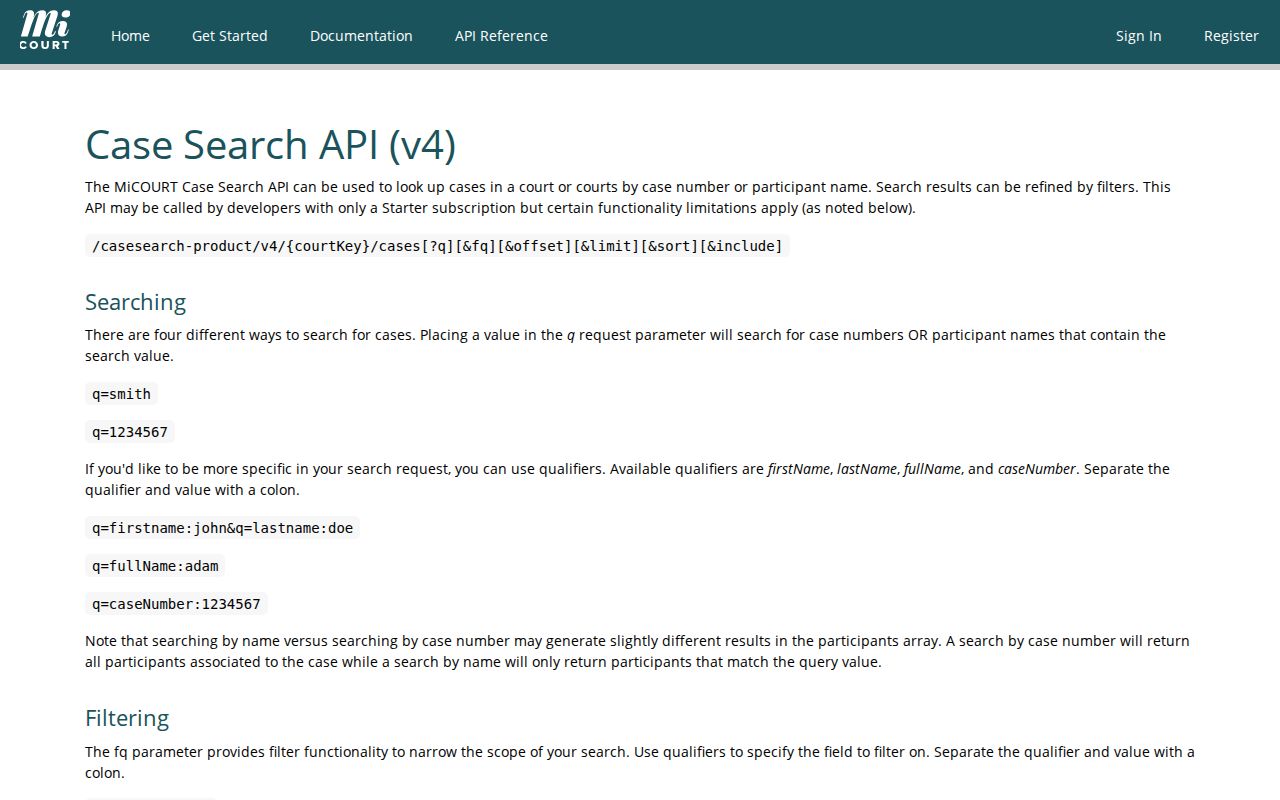
Those filters narrow a Sanilac County case lookup nicely. They grant no right to bulk collection, and they do not replace the clerk's public-access procedure for court records.
Sanilac Case Search Access Levels
Basic public MiCOURT search carries no stated access fee when results appear. Secured Web Inquiry is different. It can open broader ROA or calendar material. But only authorized users get in, and a secured login is not a workaround for the public side of a Sanilac County docket search. Nobody should try to slip past a limit. Switching account types does not bypass a suppression or category exclusion. The MiCOURT public search landing page posts informational-use and access notices. It needs JavaScript, and maintenance, rate limits, or public-status restrictions can affect it. That public screen is the right online starting point. Use it first for a specific Sanilac County court record question. The official page itself names its court and category choices.
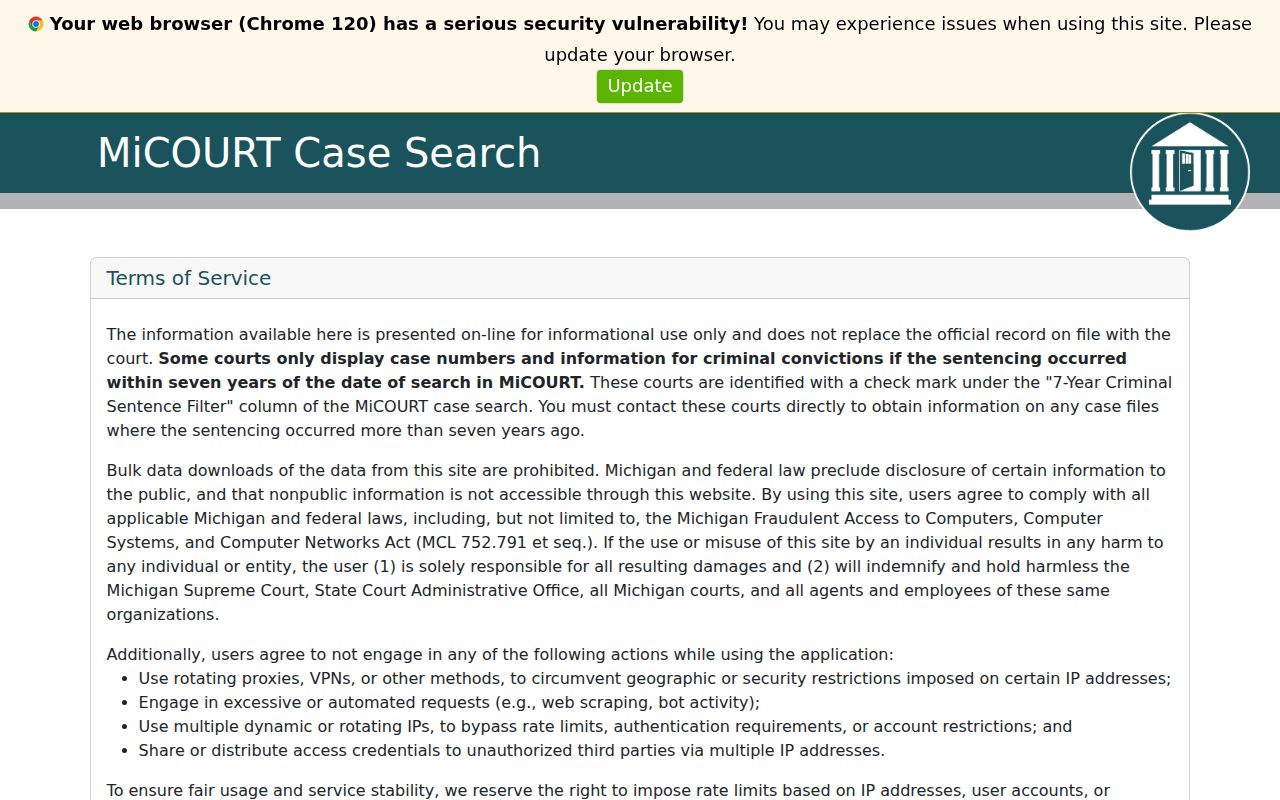
Frame a focused Sanilac County lookup on that screen first. If the record you need is not displayed, take the question to the clerk or the public terminal.
Restricted Cases and Access Rules
Court rules, not the county FOIA route, control public access here. The main authority is Michigan Court Rule 8.119, along with the court-records standards. MiCOURT may exclude or limit whole categories of cases. Adoption, juvenile and child-protective proceedings, PPO matters, mental-illness cases, wills, and name changes all qualify. Other protected categories may be limited too. A public case number never makes every document in the file public. MCL 712A.28 sets the statutory confidentiality baseline for juvenile records. Sealed, suppressed, redacted, and not-indexed are distinct access states. Ask the Sanilac County clerk about the applicable procedure. A redacted public version may exist, and the clerk can state the authority required. An empty result proves nothing about the underlying matter.
When a Sanilac Case Search Is Empty
Start with the basics. Confirm the Sanilac County court code, category, spelling, case year, and number format. Then try a current browser with JavaScript turned on. A blank state, text-only error, or maintenance response is a technical access condition, not a case result. The portal also warns against bulk downloads and automated requests. Hammering it repeatedly solves nothing. If the case should be public but stays unavailable, do not give up. Contact the clerk who keeps the record. The courthouse public-access counter also works. Ask whether the case is older, sits in another court, is not indexed, restricted, or open only for inspection. For a scheduled appearance, confirm the date through the hearing display or the clerk instead of trusting an empty search.
Sanilac Case Search Status Words
Open, closed, disposed, deferred, mediation, ADR, garnishment, and suppressed are status terms, and each means something different. The Sanilac County ROA supplies the context for reading them. A disposition can resolve a charge or claim. Later financial, post-judgment, appeal, or satisfaction entries may still follow. Suppressed is different still. It marks a public-access limit, not an event in the case. Do not expand local code abbreviations from a statistics report unless a current code legend or the clerk confirms them. The safer route is the case category the Sanilac County court shows. Read the visible event history next. Then read any matching order. Note: Court-status labels describe only the system's current display. The surrounding Register of Actions remains the useful source of context.
Sanilac Case Results Are Informational
MiCOURT calls its public results informational, not the official record. A Sanilac County printout can still help. It can locate a case, let you follow a public matter, or confirm what the system displays. But it is not a certified copy, and it may omit documents or restricted material. Do you need an official copy, a certification, document inspection, a correction, or an answer on an older file? Go to the responsible clerk.
A hearing date deserves a second check too. Settings can move. Compare any Sanilac County result against the current court display or clerk information. The court record and the calendar work as a pair: one gives the event history, the other gives the currently scheduled public setting.